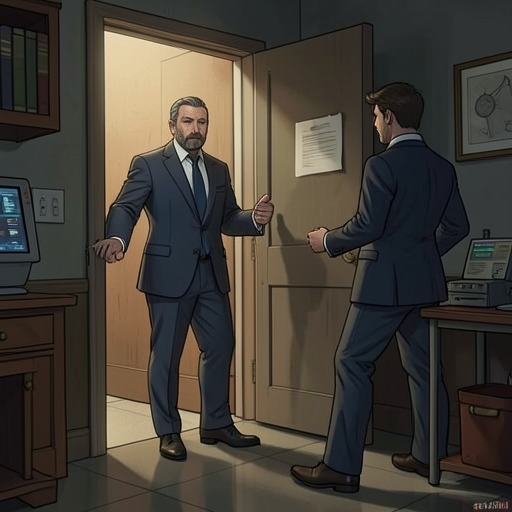
Don Challenor and Fran Revell
Panic RoomDon Challenor and Fran Revell’s post-divorce relationship is a careful mixture of personal familiarity and professional obligation. Their cordial business contact gives Fran a reason to hire Don when he is suddenly unemployed, but the assignment also makes their unresolved marital history visible: he expects indulgence, while she insists on candour, a contract, and the work itself. The relationship’s defining tension is not open hostility but the gap between Don’s self-protective reading of their past and Fran’s practical limits on what she is willing to do for him.
Marriage and its aftermath
Don describes the end of the marriage as sorrowful rather than angry, and the two have communicated cordially about business since their divorce. His account of their relationship is notably self-serving, however: he remembers the separation as relatively gentle while acknowledging that pushing his luck was what wrecked the marriage. The admission is brief, but it supplies a measure of the conduct that continues to complicate their dealings.
By the time Fran approaches him with work, she has a husband and two daughters. Don asks after this family and privately hopes that Fran’s new husband will eventually be discarded in turn. Her brisk assurance that they are fine does not invite further intimacy. Don’s lingering hope is evidence that he does not experience their past as fully settled, even as he accepts the businesslike shape their contact has taken.
In a later conversation with Blake, Don presents the history in pared-down terms: there was a marriage, then a divorce, and no children. He says that he and Fran are on good terms, while letting her name slip more than once. That version reinforces the cordiality of their ongoing contact, but also shows how readily Don speaks of Fran when talking about himself. The contrast between his claim of good relations and the wary reserve visible when they meet keeps the relationship from being reduced to either a clean break or a renewed romance.
A job that is also a test
Fran contacts Don after he has left Mendez Chinnery, where his boss dismissed him after Don’s corner-cutting. Don expects another estate agency to be his next point of contact and is surprised that Fran, a solicitor whose clients have used the firm, is the one to approach him. He interprets her choice of a nearby coffee shop as a preference for an informal meeting, and even considers suggesting a bar. He does not press the idea, recognizing that pushing his luck contributed to the failure of their marriage.
At the meeting, Fran does not begin by offering reassurance or a job lead. She asks Don to explain the “ethical differences” that, according to Ben, led to his departure. Don blames his former boss rather than examining his own conduct. Fran closes her eyes and wonders aloud whether the meeting was a mistake. Her response establishes the terms of their renewed association: she knows him well enough to recognize the evasion, and familiarity does not require her to endorse it.
Fran has no promising vacancy to offer, but she does have an urgent job for someone available at short notice. Don thanks her for thinking of him; Fran admits that she cannot seem to stop, though only occasionally. The exchange allows affection to surface, then immediately contains it. Her help is real, but it is neither a promise of reconciliation nor an invitation for Don to treat the assignment as a private favour.
Professional boundaries and concealed stakes
Fran makes those boundaries concrete by placing two copies of a standard freelancer contract on the table and telling Don to sign both. Don asks whether a contract is really necessary. Fran answers that she is a lawyer and reminds him how much she saved him on their divorce. He smiles at what he considers a considerable misrepresentation, then reads the document and signs while she taps at her iPhone. Their shared history is present in the joke, but the contract governs what happens next.
The assignment concerns Wortalleth West and a property connected to Jack Harkness. Don recognizes the Harkness case and asks whether Jack is the owner. Fran reveals that Harkness is her client’s soon-to-be-ex-husband, not the owner of the asset: the client owns it and is entitled to sell. She says she would not otherwise be involved. Don objects that Fran should have told him earlier, because he dislikes being taken for a ride. Fran rejects the accusation and points out that disclosure would only have brought the same argument forward by a day.
Her instructions are unambiguous: Don is to get rid of the cleaner, measure the house, value it, and send her the information by Monday. She also reminds him that his generous fee is payment for completing that work. The concealed client relationship changes Don’s understanding of the job, but it does not change its defined scope. Fran’s insistence that the asset belongs to her client, and that the sale is lawful, separates her professional judgment from Don’s suspicions about Harkness.
Familiarity without indulgence
Don and Fran’s exchange repeatedly turns on the difference between help and exemption. Don arrives expecting a relaxed conversation and later expects to be told enough to feel he has not been misled; Fran offers paid work, gives him the relevant explanation when challenged, and refuses to soften the terms. Her rebuke about the circumstances of his dismissal links the present dispute to the qualities that damaged his career. In her view, Don cannot claim a grievance against others while ignoring his own contribution to it.
Yet the scene is not simply antagonistic. Fran has thought of Don at a moment when his prospects are poor, and her occasional affection remains perceptible beneath her briskness. Don, for his part, observes her appearance and expression closely, takes pleasure in the familiarity between them, and continues to imagine himself as someone with a reserve of goodwill. The relationship’s warmth survives, but it is conditional: it does not cancel the divorce, excuse his conduct, or remove the need for a signed contract.
Significance
Their renewed professional connection gives Don immediate work after Mendez Chinnery and draws him into the sale of Wortalleth West, while making his habits of self-justification part of the conflict. Fran functions as both former spouse and solicitor: she knows the personal history behind his behaviour, but conducts the assignment through legal and commercial boundaries. The result is an uneasy, workable intimacy in which concern and criticism coexist. Don can still read Fran’s help as evidence of affection; Fran’s actions show that caring about him does not mean letting him define the terms.